Every generation has a moment where the ground feels unsteady. Where organizations are questioned, trust is fractured, and the noise is so loud it’s hard to tell truth from narrative. We are living in one of those moments now.
Headlines with “if it bleeds, it leads” hooks. Videos without context. Sound bites lacking substance. And somewhere in the middle of it all, real people are still showing up to work. They get up, put on uniforms, answer calls, step into chaos they didn’t create and can’t control.
We are told to choose sides. To simplify. To play Monday-morning-quarterback. To become armchair experts on topics we don’t understand. To paint with a broad brush.
There’s no denying that change is needed. Accountability matters. Oversight matters. Reform matters. Communities deserve transparency and trust, and when that trust is broken, it must be repaired – not ignored or excused.
While social media rage baits and legislative policies are proposed at lightning speed, the reality on the ground has not paused. Crimes still happen. Accidents still occur. Domestic calls still turn volatile. Mental health crises still unfold in real time, without hashtags or comment sections.
And when those moments happen, someone still dials 911.
They are not met with slogans. They are not met with protest propaganda. Instead, they are met by a human voice on the other end of the line – calm and reassuring – on what is often the worst day of the caller’s life.
From a distance, it is easy to reduce law enforcement and emergency response to an idea. Much harder to reconcile that idea with the exhausted officer finishing a double shift, or the dispatcher sitting in silence after a traumatic call, taking a breath before answering the next line.
Emergency responders are not symbols or political talking points. They are humans in a uniform.
They carry families with them into every shift. Families who feel every headline, every accusation, every broad-brush condemnation. Their children face cruel comments at school from peers who don’t understand the weight their parents carry. Their spouses are confronted in grocery store aisles, shunned in public spaces, or refused service simply because of a last name or association. The attacks on the badge do not stop at the end of a shift; they follow officers home.
These men and women absorb trauma the public never sees. They respond to calls that permanently change them, then are expected to return to normal life as if nothing happened. They witness loss, violence, and devastation – often many times during a single shift – and are still expected to show restraint, compassion, and professionalism in moments most people will never experience.
And yes, there are times when someone who should have NEVER worn the badge betrays the profession and tarnishes it for everyone else. That damage is real, and it must be addressed honestly and decisively.
But it is unjust and dangerous to ignore the humanity of the many because of the failures of a few.
Law enforcement is not made up of machines or monsters. It is made up of mothers and fathers. Sons and daughters. People who feel deeply, love fiercely, and still show up day after day to serve communities that may never know their names.
We can acknowledge failures without erasing service. We can demand better systems without demonizing every person inside them. We can grieve injustice while still recognizing that safety is not optional.
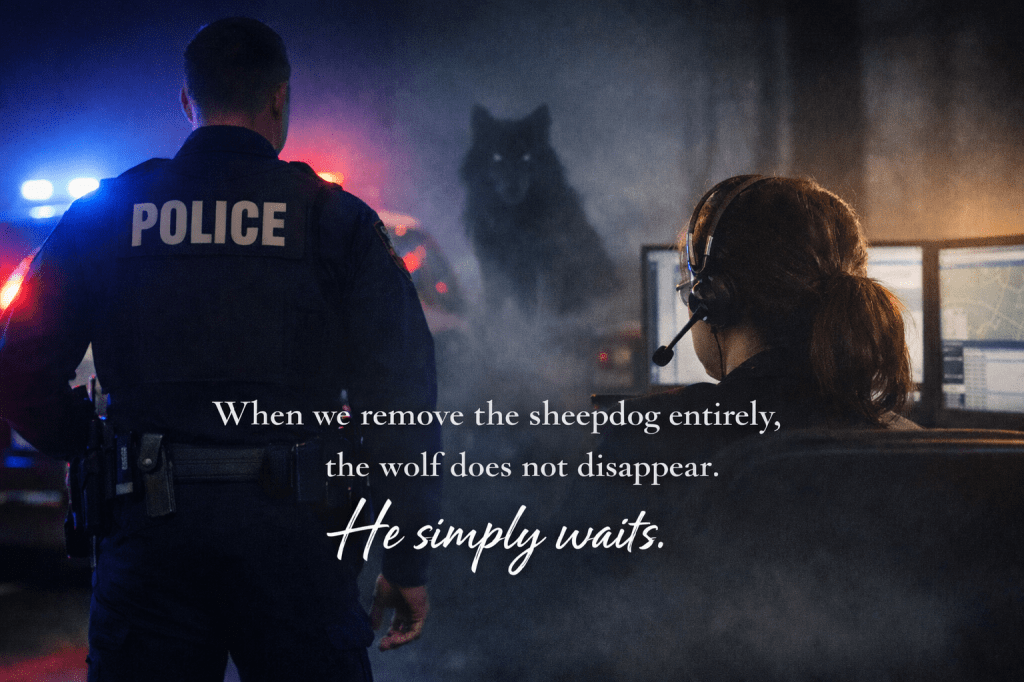
History shows us this much: when we remove the sheepdog entirely, the wolf does not disappear. He simply waits.
This moment will pass, as all moments do. The question is: what will we have built or dismantled by the time it does?
Because long after the protests end and the news media moves on to the next big story, someone will still be needed to stand in the gap. Someone will still answer the call. Someone will still hold the line.
 Peace In The Margins
Leave a comment